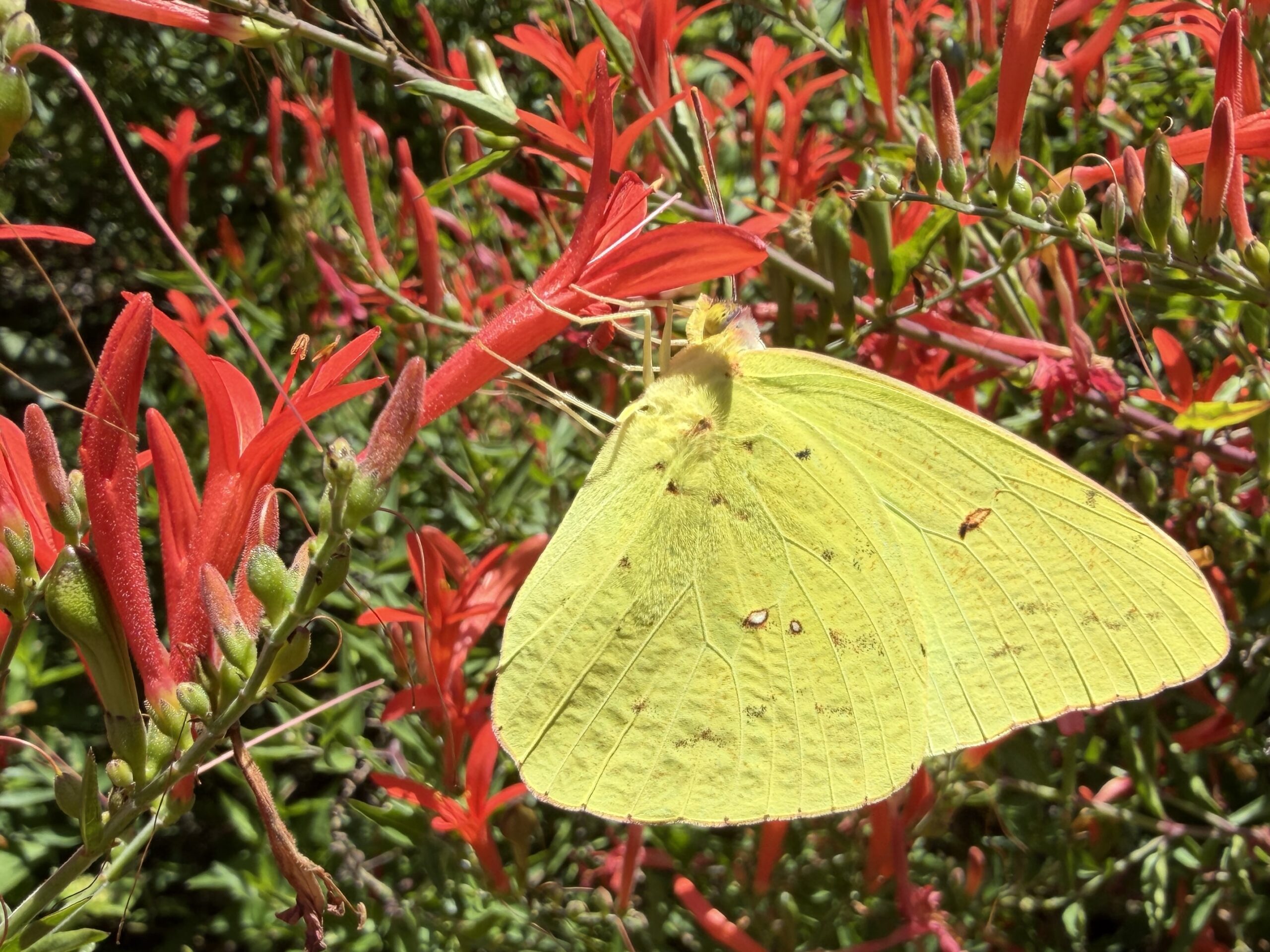
Have you seen them? Splashes of bright yellow at about hip high bobbing over the garden, along the road, and across the fields. In ones and twos, but sometimes masses of butterflies tumbling over each other, and it seems like they’re in a hurry. Cloudless sulphurs are traveling south, activated by cooling nights and shorter days. Like Monarch butterflies, they are migrating, and they’re looking for native plants.
We know a lot about Monarch migration, but tend not to see them here in huge numbers since they fly hundreds of feet above the ground. Cloudless sulphur butterflies travel at a human level. They don’t have a pinpoint location like Monarchs moving toward Mexico’s oyamel fir forests, but aim toward frost free zones across Florida and the Gulf coast. As Cloudless sulphurs (Phoebis sennae) begin congregating in these warmer zones, their flight becomes a spectacle. In late fall, their numbers “crossing an east-west line bisecting the Florida peninsula at the latitude of Gainesville may approach the numbers of monarchs overwintering in clusters at highly localized sites in Mexico,” according to studies in the state.
Strangely, you may see some going the other way. For unknown reasons, a portion of cloudless sulphurs move purposefully north. These will not survive freezing winters. Once south-going butterflies arrive in Florida they spend the winter between Gainesville and Lake Okeechobee. They slow down, stop breeding, and eat only occasionally. This state is called diapause. Adult butterflies with a usual lifespan of two-to-four weeks will live for months. When spring warms the Southeast again, they’ll fly north, and begin to breed and lay eggs on their host plants. Like Monarchs, their successive generations will keep pursuing native plants northward until the seasonal signal comes to turn south again.
Our native plant gardens can become part of this wondrous process. Adult butterflies have long tongues and prefer tubular flowers, especially red. If you’re growing hummingbird plants, you’re helping sulphurs, too. Think red buckeye, red columbine, coral honeysuckle, crossvine and trumpet vine, penstemon, Hibiscus, morning glories, scarlet sage, and Lobelia (red and blue).
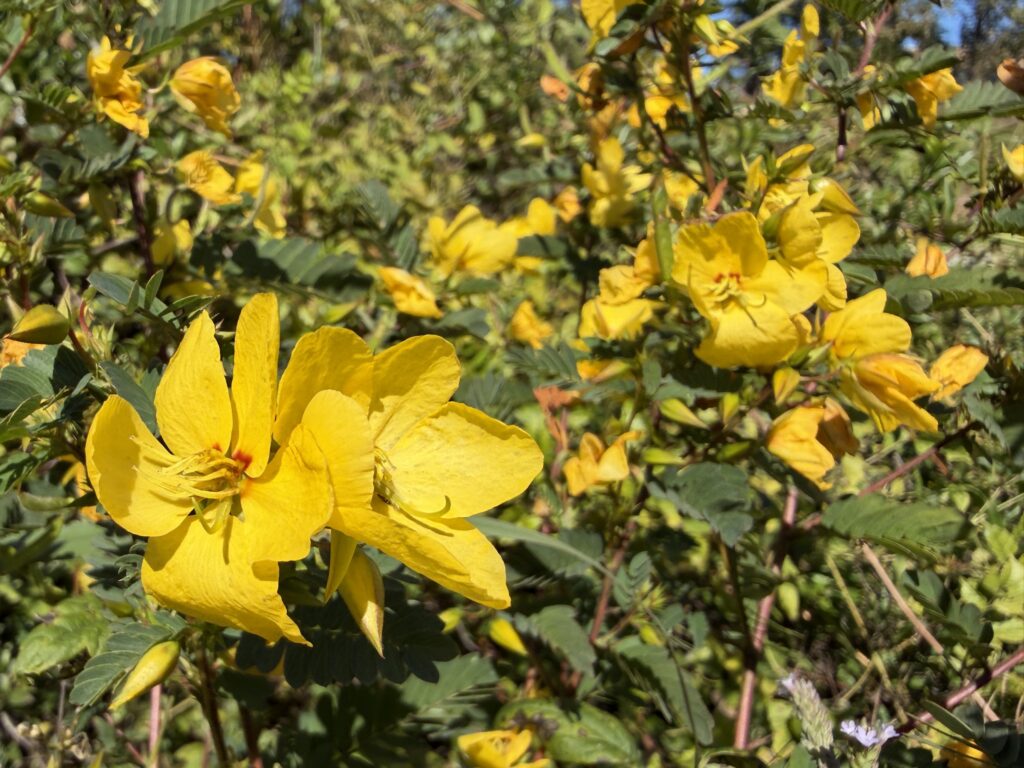
But their caterpillars need to eat plants not typically thought of as garden mainstays: plants in the genus Senna and Chamaecrista. Sicklepod (Senna obtusifolia) and partridge pea (Chamaecrista fasciculata) are the most commonly found host plants here in South Carolina, and happen to be huge food sources for lots of other pollinators, too. Let some of these wild plants grow or introduce them to your gardens. (Be aware of some introduced invasive Senna to avoid.) And watch for cloudless days to come again.
Note: the red-flowered plant pictured is Anisacanthus quadrifidus var. wrightii, not native to South Carolina but Texas, brought to the Midlands from the author’s home state.