By Sue Watts, SC Botanical Garden Educational Program Coordinator and SCNPS Member
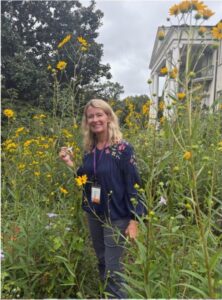
Botany teacher Allison Bowden in the garden at Ashley Hall, Charleston. Photo Credit: Ashley Hall school
In September 2025, the South Carolina Native Plant Certificate Program celebrated a double-digit birthday! Over the past ten years, hundreds of people have enrolled in certificate classes to learn about all aspects of South Carolina’s native plants, plant communities, wildlife ecology and more.
Our 10th anniversary is an excellent opportunity to begin highlighting some of the graduates who have benefitted from the program and spread their new knowledge into the world. For the first in a series of graduate spotlights, I interviewed Allison Bowden, a botany teacher at Ashley Hall in Charleston. Allison was also an integral participant in the first “Native Plants for Pollinators Teacher Workshop” at the South Carolina Botanical Garden in 2023. See the link at the bottom of this page to register for this year’s workshop.
1. What in your background and teaching experience sparked your interest in plants?
I’ve spent the past 20 years in the classroom as a biology teacher and eight years teaching Honors Botany at Ashley Hall in Charleston, SC. I was raised in Clemson, SC. I earned a Bachelor of Science degree in Biology from Wofford College and a Master of Science degree in Environmental Science from Antioch New England Graduate School.
Plants are practically in my DNA. My great-grandfather owned a plant nursery, my grandfather hybridized irises, my father grows and hybridizes bromeliads, and my mother holds a master’s degree in botany. Growing up surrounded by plant enthusiasts, it’s no wonder I developed a lifelong passion for the botanical world.
But despite being part of my family legacy, I’ve realized that plants often take a back seat to other organisms. Many people, including some of my students, don’t see them as living, dynamic beings. That’s why I love watching my students’ faces light up when they discover that plants can reproduce sexually, respond to stimuli, and even communicate with each other! It’s like uncovering a secret world that’s been right under their noses all along. Plants are the unsung heroes of our natural world—quietly working their magic behind the scenes.
It’s my mission to give my students the knowledge and appreciation they need to become stewards of our botanical treasures.
2. Why did you take the certificate program?
When I decided to propose the botany course at Ashley Hall, I wanted the curriculum to be based on South Carolina’s native plants. After starting the course, the opportunity came up to create a native plant garden on campus. I knew that to do this well and use it as a teaching tool in the classroom, I would need some training. The SC Native Plant Certification program was the perfect fit!
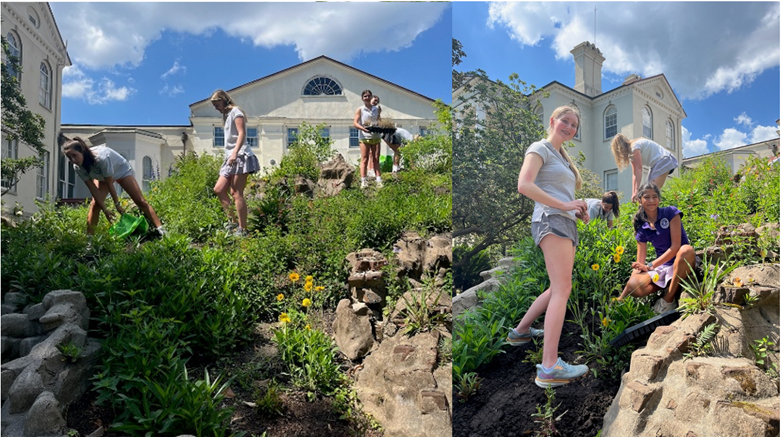
Students at Ashley Hall School in Charleston, SC, working in a unique native plant garden on their campus. (It surrounds what was once a bear cave for the former landowner’s pet!) Photo credit: Ashley Hall school.
3. Did participating in the certificate program change your perspective on native plants, native habitats, or ecology?
Absolutely! Not only was I able to transform part of our campus using native plants, I also converted my front yard at home into a native plant haven! You always hear how natives will attract pollinators, but you don’t really believe it until you see it. It has been incredible to watch the biodiversity increase on our campus (and at my house!) each year!
As the gardens become more established, we see an increase in the number of butterflies, bees, wasps, and beetles. Hummingbirds become residents as cloudless yellow sulfurs, monarchs, and Gulf fritillaries feed constantly during the blooming season. It has been a wonderland for students of all ages at Ashley Hall, and you will see them visiting the garden and observing the busy insects. Our native garden has truly become an outdoor learning laboratory.
4. Did participating in the program help with your work? If so, how?
The SC Native Plant Certification took a few years for me to finish. This program became my professional development, and I received full support from my administrators to pursue and complete the certification. It helped support my goal to provide a meaningful course on botany and to ensure the curriculum was built on solid plant science.
How this program really helped with my work is expressed in this article I wrote a while ago:
Imagine a school campus with its very own cave—not just any cave, but one originally designed to house a black bear! At Ashley Hall, this unexpected gem has transformed from a bamboo-choked thicket into a vibrant sanctuary of natural beauty and pollinator magic. Today, it’s a thriving learning laboratory filled with native plant species, lovingly cultivated by Ashley Hall Upper School students over the past seven years.
The transformation is the work of the Honors Botany class, a unique junior/senior elective where students dive into the wonders of botany—exploring ecology, evolution, energy, genetics, and biological systems. This is no ordinary classroom. Here, students get their hands dirty, digging into real-world applications of plant science as they tend the native plant garden and campus greenhouse. It’s the perfect course for curious minds who crave hands-on learning and want to make a real impact on the environment. Whether nurturing seedlings or restoring native habitats, these students are cultivating more than just plants—they’re growing knowledge, passion, and a deeper connection to the natural world.
We were absolutely thrilled when our native plant work at Ashley Hall earned the Larry T. Mellichamp Memorial Award for Conservation at the 2024 Cullowhee Native Plant Conference. This award honors the legacy of Dr. Larry T. Mellichamp—a beloved botany professor at UNC-C and a passionate advocate for native plants through the N.C. Native Plant Society. Receiving regional recognition for our innovative efforts was an honor, and a testament to the dedication and hard work of our students and community. We couldn’t be prouder to carry forward Dr. Mellichamp’s legacy by fostering a love for native plants and conservation.
5. Did you have a favorite class in the program?
Oh goodness! I had so many! I loved the nature journaling class with Gale McKinley, and propagation with Ryan Merck. I enjoyed the classes that were content heavy too, because I love having the information to build my own curriculum. The classes that included “outside” time were also a favorite as we put our skills to work in the field.
6. Is there anything else you would like to share about your experience in the program?
I love to learn. And I especially love to learn about things I am interested in or care about. Plants are top on the list for me, and this certification program was the perfect fit! It enriched my teaching and directly benefited my students, and it also helped me create a more eco-friendly landscape in my own yard.
This certification program requires time, commitment, and focus. But the rigor was exactly what I was looking for. I didn’t want a fluffy field trip. I wanted to learn more about native plants and not just their names, but their uses, ecological roles, and how we can restore our local landscapes. Thank you for this unique and special opportunity to be part of such an important program. It has helped me network and make new connections with others who are like-minded. I recommend this to everyone, whether you are a formal educator or not!
Our next free teacher workshop is available online – classroom teachers register here
Image Credits
Photos provided by the Ashley Hall School