
by Jon Storm
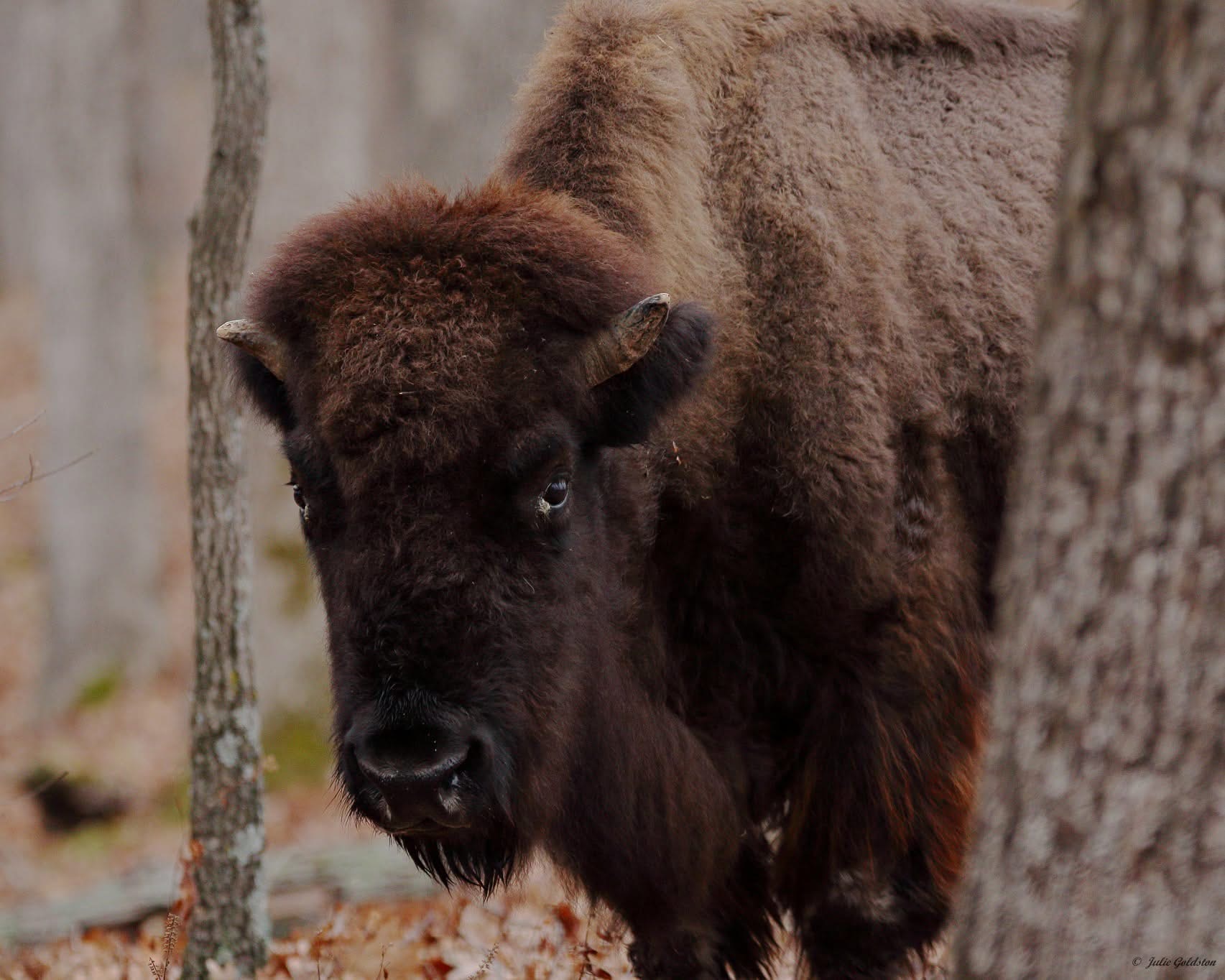
Imagine being a settler in the Upcountry of South Carolina in January of 1750. It’s early in the morning and you’re outside brushing your teeth with a sassafras twig when a large brown object in the distance catches your eye. Looking more closely, you realize it’s a bison. A bison in the Upstate? You bet! Before the largest land mammal in North America became a symbol of the American West, it was also roaming the grasslands, savannahs, and canebrakes of the American South.
In the coming months, we’ll discuss the history of these habitats and their distinctive plant communities here in the Upstate. To start things off, though, let’s learn a bit about the history of bison (also called buffalo in the United States) in the Upstate of South Carolina and surrounding regions. Bison are a well-known keystone species in the prairies of the West. As a keystone species, bison have a large impact on the structure of their ecological community. This is analogous to the keystone at the top of a Roman arch playing a central role in the structural integrity of the arch. In the piedmont prairies of the Upstate, grazing by bison may have helped maintain piedmont prairie habitat for native plants that are rare today such as the Schweinitz’s sunflower (Helianthus schweinitzii) and Georgia aster (Symphyotrichum georgianum).
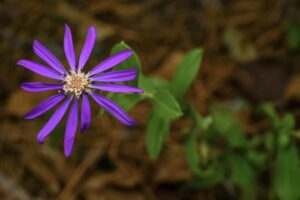
Georgia aster (Symphyotrichum georgianum) is native to dry, rocky woodlands of the southeast.
One of the earliest references to bison comes from Mark Catesby’s explorations through the Carolinas from roughly 1722 – 1725. Catesby saw bison on his travels and described them in his Natural History as, “They frequent the remote parts of the country near the mountains, and are rarely seen within the settlements. They range in droves, feeding in open savannas morning and evening, and in the sultry time of the day they retire to shady rivulets and streams of clear water, gliding thro’ thickets of tall canes.”
Robert Mills, an early American architect and designer of the Washington Monument, wrote a book on the History of South Carolina and described the presence of bison in the Laurens District of South Carolina. In his 1826 book, Mills wrote, “In the year 1750, when the first settlement was made, the buffaloes were so numerous, that it was not uncommon for three or four men with dogs to kill from ten to twenty a day; these animals have entirely disappeared.”
By the 1700’s, though, bison had been hunted to local extinction across the Carolinas. Some of you may be familiar with the Bull Creek Valley pull-off at milepost 373 on the Blue Ridge Parkway. The sign at this stop proclaims, “The last buffalo seen in this locality was killed nearby in 1799 by Joseph Rice, an early settler.” Although the thundering hooves of wild buffalo no longer echo across the Upstate, there are some reminders of their presence. One example is the small town of Buffalo in Union County, South Carolina. It’s named after the large number of bison (or buffalo) that used to gather in that area at Buffalo Lick Springs.
Sources
Catesby, Mark. 1731. The Natural History of Carolina, Florida and the Bahama Islands. Volume I, London.
Mills, R. 1826. Statistics of South Carolina, Including a View of the Natural, Civil and Military History, General and Particular. Hurlbut and Lloyd, Charleston.
Rostlund, Erhard. 1960. The Geographic Range of the Historic Bison in the Southeast. Annals of the Association of American Geographers. 50: 395-407.
Workers of the Writers Program. 1941. Palmetto Place Names: their Origin and Meanings. Sloane Printing Company, Columbia, South Carolina.
Image Credits
Bison used to roam across South Carolina. Photo by Julie Goldston
Georgia aster (Symphyotrichum georgianum) is native to dry, rocky woodlands of the southeast. Photo by Jon Storm