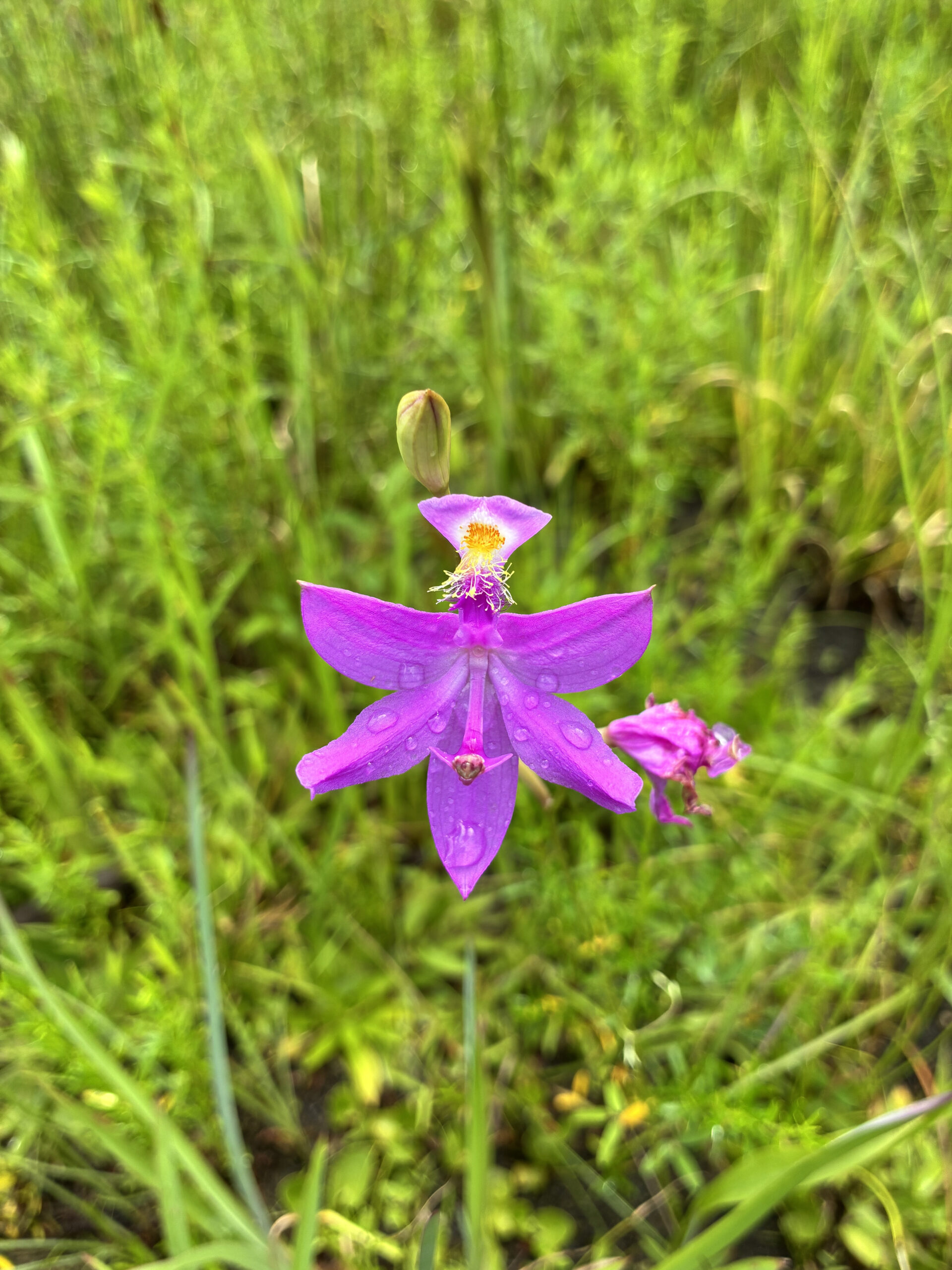
If you are anything like me, you are tired of this South Carolina winter. Albeit short, I am ready for longer, warmer days and of course flowers! Nothing says summer like the array of color provided by our native wildflowers. Among our brightest is the grass pink orchid, Calopogon tuberosus.
The grass pink orchid is common throughout the east coast where it can be found growing in a variety of wet habitats such as savannahs, prairies, and bogs. As far as orchids go, this one is fairly common in the horticultural trade as well and grows easily in a sunny bog garden. The genus Calopogon comes from the Greek, combining “kalos” and “pogon” which means beautiful beard. This refers to the colorful hair-like structures on the labellum (modified petal) of the flower (more on that in a second). The species name tuberosus refers to the underground tuber-like corm. The flowers can be found in varying shades of pink and on rare occasions pure white.
Like so many orchids, what makes this plant truly interesting (to me) is its pollination ecology. The first interesting aspect is the labellum itself. In most orchids, the flower bud rotates as it develops so that the labellum is at the bottom of the flower when it opens. In the case of the grass pink, it does not rotate leaving the labellum at the top of the flower. This is called an unresupinate flower. At the opposite end of the labellum is the column, or reproductive structures of the flower. Remember those hair-like structures on the labellum? Well these hair-like structures actually mimic the appearance of pollen. This pseudopollen attracts hungry insects looking for a snack. When they try to land on the labellum, the weight of the insect causes the labellum to hinge at its base, lowering the insect onto the column where the real pollen sticks to its back. The still hungry insect flies off and tries its luck on another grass pink flower where the same process deposits the pollen stuck on its back onto the flower. To see a visual explanation check out this video.
Don’t worry, the warmer weather is right around the corner and hopefully you get a chance to see one of these beautiful flowers in the wild or even get to add one to your garden!
Photo by Tierney Rosenstock