
By Katie Dickson in March 2013 Upstate Happenings
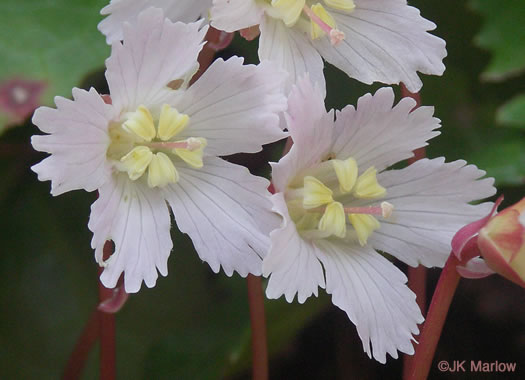
Oconee bells (Shortia galacifolia) is a very rare Southern Appalachian native plant belonging to the family Diapensiaceae. It features glossy, round, deep green leaves and gorgeous fringed white to pink bell-shaped flowers which give the plant its common epithet; it spreads by shallow underground runners called rhizomes. It is often found growing on partially shaded banks alongside rhododendrons and other acid-loving Ericaceous species. The Southeast is home to two varieties, var. galacifolia and var. brevistyla which differ in the length of their styles (var. brevistyla being a few millimeters shorter). S. galacifolia occurs in Jackson and Transylvania counties in North Carolina, Rabun County of Georgia, and of course Oconee and Pickens counties in our home state. Var. brevistyla is found in McDowell county of North Carolina and is native nowhere else. Shortia sightings have been reported from many other counties and states but these are suspected of being persistent from cultivation.
After seeing a fragment of Shortia in the Paris herbarium in 1838, celebrated American botanist Asa Gray was intrigued, and he began a tireless search for it. It had been originally collected by Andre Michaux in the late 1700s from a place that his notes described as the “high mountains of Carolina.” Thus Gray focused his searches in the North Carolina mountaintops. It was not until 1877, on a hillside near the Catawba River, north of Marion in McDowell County, NC, that a 17-year-old youth named George Hyams rediscovered the plant. Discover this fascinating plant for yourself at Devil’s Fork State Park, Gorges State Park, and the South Carolina Botanical Garden. The SCBG has a beautiful pink flowering form, which had its first bloom of the year on February 11th, and February 1st the year before (two of the earliest flowering dates we’ve ever seen!). Oconee Bells are a rare and wonderful native, and there is nothing quite so enchanting as finding a patch of these diminutive plants on the forest floor. —
Image Credit
Photo by JK Marlow
