By Jon Storm, Co-Director of Publicity & Social Media
Everyone knows about the United States’ Semiquincentennial on July 4, 2026, but did you know that the South Carolina Constitution has a Semiquincentennial this month? March 26th marks the 250th Anniversary of the state constitution. South Carolina was the second state to adopt a constitution, following New Hampshire by just a couple of months. In celebration of this event, let’s review some of the plants that have become symbols of our great state, starting with the cabbage palmetto.
Cabbage Palmetto (Sabal palmetto)
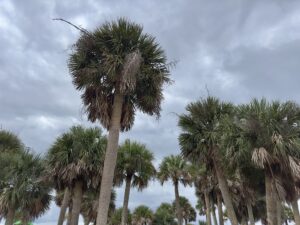
Cabbage Palmettos on Hunting Island, South Carolina.
This native tree was designated as our state tree on March 17, 1939. The cabbage palmetto was a symbol of our state long before then, though. The symbolic nature of the cabbage palmetto dates back to an unnamed and partially built fort on Sullivan’s Island. On June 28, 1776, four hundred soldiers of the Second South Carolina Infantry under the command of Colonel William Moultrie defended the mouth of Charleston Harbor from attack by the Royal British Navy. Despite being outmanned and outgunned, Colonel Moultrie and his men were victorious, due in part to the fort being built from Cabbage Palmetto logs and sand. The spongy nature of the fibrous palmetto logs withstood bombardment from British cannons and Charles Town (Charleston) was successfully defended by Col. Moultrie.
To commemorate the importance of this native tree in the defense of the city, the cabbage palmetto was incorporated into the State Seal of South Carolina later that year. Eighty-five years later, the Cabbage Palmetto was incorporated in the South Carolina State Flag, where it still resides to this day.
The cabbage palmetto is native to within roughly 10 miles of the coastline but it has been widely planted further inland. Its “cabbage” name comes from the terminal bud at the top of the tree. This is where new leaves grow from the top of the trunk. Some people say the taste of the bud resembles cabbage, and the name stuck. Harvesting the terminal bud kills the tree, though. Clusters of black fruits appear on the cabbage palmetto in autumn and they are consumed by songbirds and small mammals.
Carolina Jessamine (Gelsemium sempervirens)
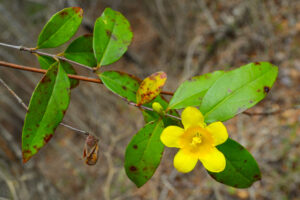
Carolina Jessamine is the South Carolina State Flower.
This perennial woody vine was selected as our state flower in 1924. According to the Report of Committee on State Flower, there were four key reasons it was selected:
- It is native to all parts of South Carolina.
- It is a symbol of the return of spring.
- Pleasant fragrance and flowers that suggest the purity of gold.
- Its annual return from the dead of winter shows loyalty and patriotism to the State.
Carolina Jessamine blooms during March and April in the Upstate. You’ll find this native vine in open woodlands, woodland edges, roadsides, and along stream banks. It grows well in sunny yards and is often available at our Upstate Native Plant Sales. Planting information is available on our SCNPS Plant Directory.
Tall Goldenrod (Solidago altissima)
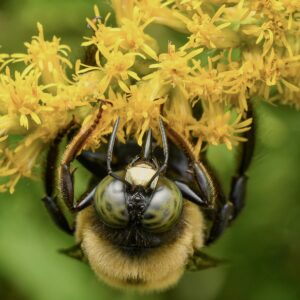
Goldenrods are visited by lots of pollinators in late summer.
This native plant was selected as our state wildflower in May of 2003. There are two subspecies of tall goldenrod in South Carolina, with the Southern Tall Goldenrod being more abundant here in the Upstate. If you’ve ever walked through a field of goldenrod in late summer or autumn, you know its flowers attract a wide range of pollinators. The Bill for its designation as our state wildflower even extolled some of the virtues of this plant, stating:
“Whereas, Goldenrod is a strong, fibrous perennial found in meadows, fields, and along roadsides which grows in full sun to part shade needing only average moisture, making it a very tough and durable plant; and
Whereas, Goldenrod, contrary to popular belief, does not cause allergies to flare as the Goldenrod pollen is too heavy to blow in the wind; and”
Our SCNPS Native Plant Directory lists several goldenrods native to the Upstate, including Licorice Goldenrod and Slender Goldenrod.
Sources
https://www.scstatehouse.gov/sess115_2003-2004/bills/3233.htm
https://www.scstatehouse.gov/studentpage/coolstuff/EarlySymbolsActs/H&SAdoptFlower1924.pdf
Weir, Robert M. 1997. Colonial South Carolina: A History. USC Press.