By Jon Storm, Co-Director of Publicity & Social Media
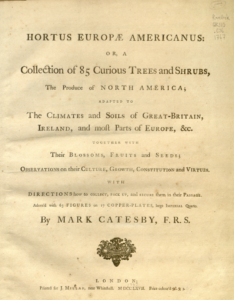
Cover page of Hortus Europae Americanus by Mark Catesby. From the Internet Archive.
English Naturalist Mark Catesby traveled through the Carolinas from 1722 to 1726, describing the native plants and animals he found in these colonies. Although he is best known for his book Natural History of Carolina, Florida, and the Bahama Islands, Catesby had another book, Hortus Europae Americanus, that was published posthumously in 1767. This book included paintings and descriptions of plants he had seen in the colonies, including here in South Carolina. As the full title of this book will attest (Figure 1), the intent of this book was to inform European aristocrats and gardeners about the virtues of useful plants here in America.
In the very first sentence of the preface, Catesby makes the purpose of his book clear to the reader. He states, “It will easily be imagined that a forest of a thousand miles in length, extending twenty degrees in latitude from north to south (for such is the territory of the crown of Great Britain on the continent of America) must afford a plentiful variety of trees and shrubs, that may be usefully employed to enrich and adorn our woods by their valuable timber and delightful shade; or to embellish and perfume our gardens with the elegance of their appearance and the fragrancy of their odors; in both which respects they greatly excel our home productions of the like kind.”
Below are three of the plants Catesby included in Hortus Europae Americanus.
Sweetgum (Liquidambar styraciflua)
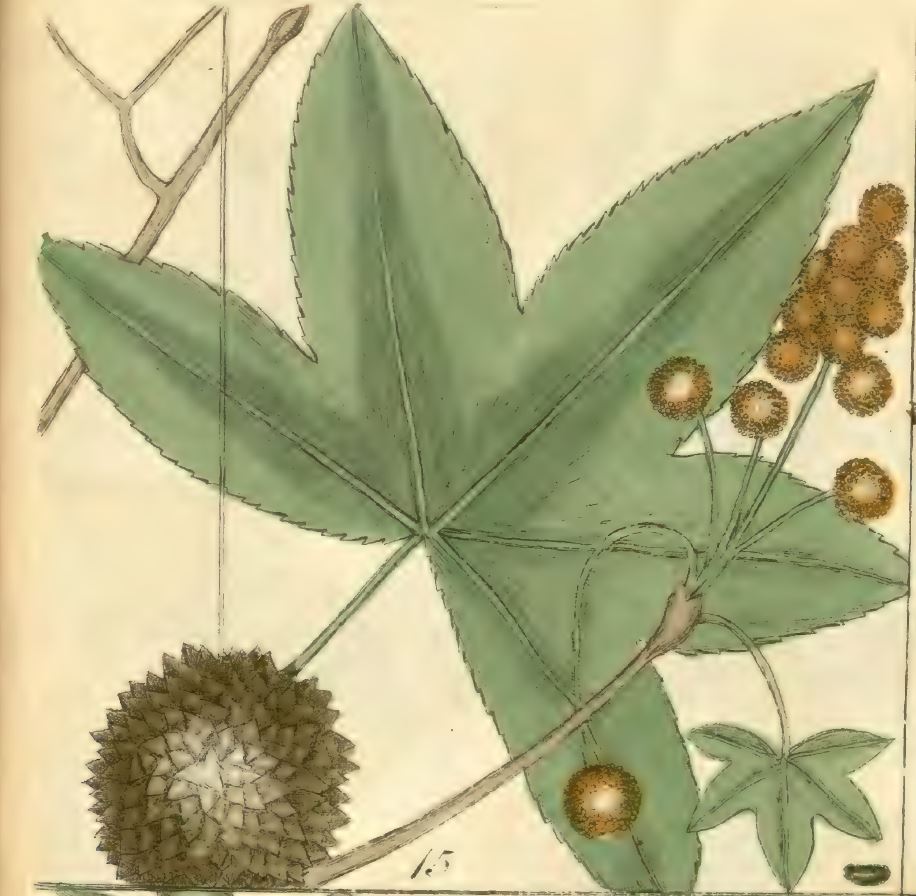
Watercolor of Sweetgum by Mark Catesby. From Hortus Europae Americanus, Internet Archive
If you mention this tree to someone today, their reaction is often derogatory, and centered on, “Those darn gumballs!” But Catesby found beauty in our native Sweetgum. He wrote that, “In February, before leaves are formed, the blossoms begin to break forth from the tops of the branches into spikes of yellowish, red, pappous, globular flowers…”
Mark Catesby was also intrigued by the resin that gives this tree its common name. He noted that both Native Americans and colonists collected this resin as a sort of chewing gum, stating “…from between the wood and the bark there issues a fragrant gum, which trickles from the wounded tree, and by the heat of the sun congeals into transparent resinous drops; which the Indians chew, esteeming it a preservative of the teeth…”
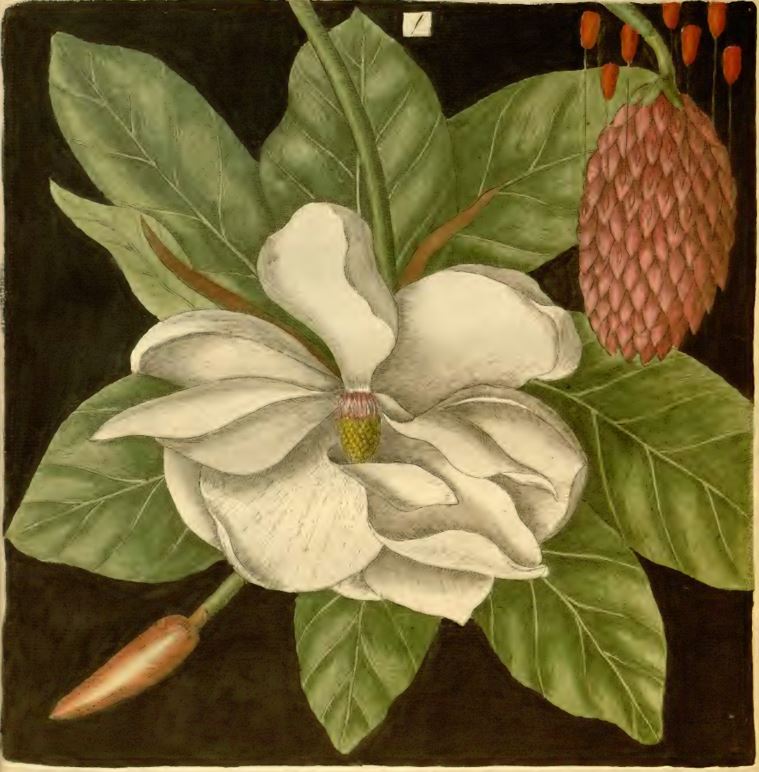
Tulip-tree (Liriodendron tulipifera)
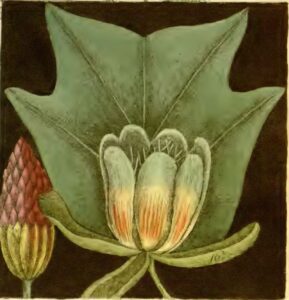
Watercolor of Tulip-tree by Mark Catesby. From Hortus Europae Americanus.
You don’t have to think too long to figure out why Catesby thought European gardeners would be interested in this native tree. The beautiful flowers of our native Tulip-tree or Yellow Poplar appear around early May here in the Upstate. Catesby noticed the flowers too, remarking “The flowers have always been compared to tulips, from which resemblance it takes its name.”
During winter, the curious fruits of Tulip-trees are often still attached to their branches. To collect them and transfer seeds to Europe, Catesby stated, “The cone it bears is composed of single-winged seeds; which, when ripe, fall from their placenta, and are dispersed far and near by the winds: so that although their cones are to be plucked before they are ripe, they should be taken at the critical time of their seeds beginning to drop…”
Flowering Dogwood (Benthamidia florida)
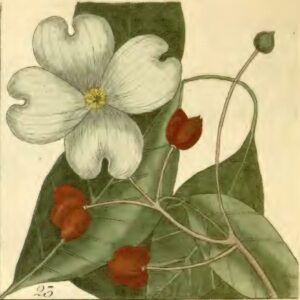
Watercolor of flowering dogwood by Mark Catesby. From Hortus Europae Americanus.
This well-known, native tree is popular across the eastern United States today and Catesby thought Europeans would feel the same way. Flowering Dogwood is one of the first native trees to bloom each spring, leading Catesby to remark, “In the beginning of March the blossoms break forth, and though perfectly formed; and wide open, are not so wide as a six-pence…”
Although many people think this tree has large white flowers, they’re actually yellowish-green! The white structures are actually modified leaves called bracts. Mark Catesby stated that, “…each flower consists of four greenish-white leaves, every leaf having a deep indenture at its end. From the bottom of the flower rises a tuft of yellow stamina; every one of which opens on the top into four small leaves or petals.”
Flowering Dogwoods bloom in England today, but it must have been rare for this to occur in Catesby’s day. He remarked that, “These trees bear the severest weather in England, without suffering any injury therefrom: they produce here plenty of suckers, by which they may be as plentifully increased. I have not heard of any flower or fruit of them produced in England.”
Back in the 18th Century, Mark Catesby saw beauty and ornamental value in many of our native plants. Thanks to the efforts of the South Carolina Native Plant Society, thousands of gardeners in our state have learned to appreciate them just as much as Catesby.
Sources
Catesby, Mark. 1731. The Natural History of Carolina, Florida and the Bahama Islands. Volume I, London.
Catesby, Mark. 1767. Hortus Europae Americanus. Available on the Internet Archive.