By Frank Holleman, SCNPS Member
On March 17, 2026, SCNPS Upstate celebrated our 30th anniversary with festivities and storytelling honoring the ingenuity and commitment of our founders and first leaders. The stories highlighted our mission-focused work, successes, good fortune, and good times.
Frank Holleman has for many years contributed his considerable expertise in environmental law through leadership of SCNPS advocacy work. The night of our anniversary celebration, he told the following story:
Common wild quinine (Parthenium integrifolium) grows at Sharpton’s Prairie. Photo by Jon Storm
One day, about 30 years ago, a Native Plant Society crew were out on a field trip driving along Highway 76 from Westminster to Long Creek in the northwestern corner of the state. From the moving car, Bill Sharpton, with the trained eye of avid plantsman and photographer, spotted a prairie plant growing near the side of the highway.
That’s the moment our story takes off!
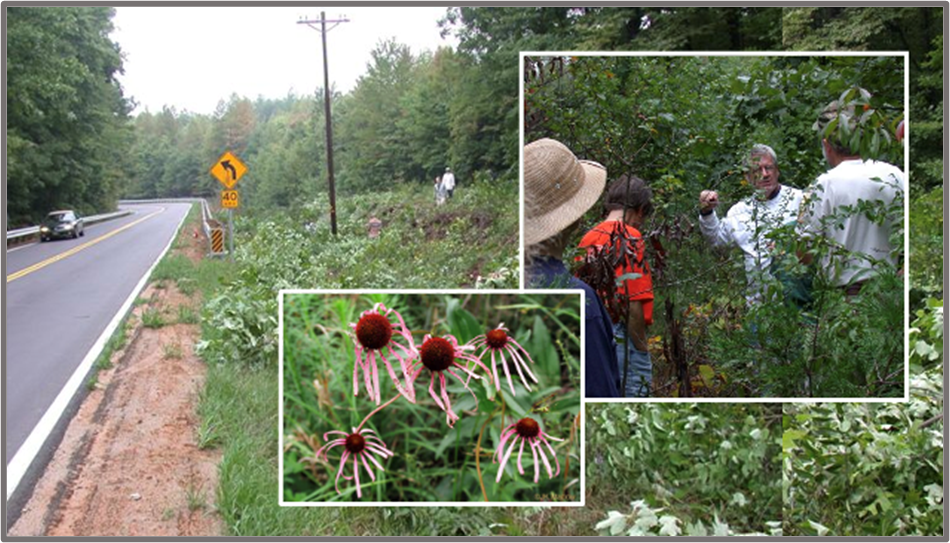
The plant was the smooth coneflower, which everyone knew to be a federally endangered species. (It’s still protected as a threatened species under the U.S. Endangered Species Act.)
The native plant crew, all volunteers, eventually returned to scope this out, and sure enough, in the ditch, in the highway right-of-way, under a Blue Ridge Electric power line, on the fringe of Sumter National Forest, they discovered a Piedmont prairie with endangered plants growing in it.
To put it in an ecological context: The smooth coneflower (Echinacea laevigata) Bill spotted was growing in a remnant of what was once a prairie environment. Some part of the area north of Westminster was apparently part of a prairie or vast grassland that thrived until the prairie vegetation began rapidly disappearing around the era of European-American settlement. Today, all we have are rare remnants of the prairie where native plants are still growing in soil undisturbed by development.
The smooth coneflower they found was indeed in danger of being obliterated, and heaven knows why it hadn’t already been obliterated. It was good that it was under a power line that was occasionally cleared out. But it bad that it was under a power line, where maintenance crews sometimes use herbicides that aren’t good for an endangered plant. And a plant that’s growing up in an environment with woody vegetation attracts the ever-energetic herbicide operators. Over time, these interventions can obliterate a prairie.
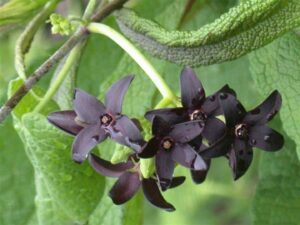
Carolina spinypod (Matelea carolinensis) occurs at Sharpton’s Prairie too. Photo by J. Marlow
Since this remnant prairie discovery nearly three decades ago, the Native Plant Society has taken upon itself to keep the area open. We talked to Blue Ridge Electric and got them to agree not to spray that area anymore, saying the Native Plant Society would take care of keeping it open. We talked to the Forest Service to let the Service know of the presence of the endangered species and to volunteer to keep its prairie open. They welcomed the Society’s involvement and on one occasion have burned adjoining land to help regenerate the prairie.
As you know, not every native plant person is a natural athlete. But never mind that, we had an all-volunteer force, including our former president Bill Stringer and Richard Cain from Oconee County, attacking the wild terrain with loppers, and occasionally, a chainsaw. They and others who’ve joined the ranks have continued to cut the woody vegetation back and kept the prairie going for 30 years!
In this roadside remnant prairie, it’s easy to spot the rattlesnake master plant and all the grasses, but the biodiversity of the prairie is greater than you’d imagine. At one time, the famous Patrick McMillan from Clemson University surveyed the site and discovered around 200+ native species in this one little stretch of roadside land a few hundred feet long.
Recently, we realized we hadn’t been keeping up with our routine as well as we should, so we had three or four volunteer workdays and cleared it out again. This time, I think the average age was probably 74. But we got it done, and as Bill Stringer and I were driving back, the phone rang in the car, and guess who called? Well, before I tell you, let me offer a word of advice: Janie Marlowe is always right! I found that out after disagreeing with her two or three times, and every time, she was right. So, you might as well just start out assuming she’s right.
So, the call was from Janie after we’d finished the workday at the prairie. She said, “Frank did you see what’s on the side of the highway?” I said, “No, I didn’t.” She exclaimed, “They’re installing 5G cable lines along Highway 76, and the spools are on the same side of the road as the prairie. So, they can potentially just come right through it!”
The long and short of the story is that when the ever-watchful and knowledgeable Janie brought this to our attention, we contacted the cable company with the help of the Southern Environmental Law Center and the Forest Service, and we brought the presence of the threatened plant to their attention. As a result, and much to their credit, the people at Charter and their contractor installed the line between the guardrail and the pavement so it would not impact the prairie.
All that our undaunted Native Plant Society team accomplished, starting with Bill Sharpton, looking out the window and spotting the smooth coneflower, has ensured that this remnant population of one of the rarest species in the Southeast, and even in the country, continues to have a chance to persist on that site. And that’s why we call this place “Sharpton’s Prairie.”
This story characterizes what our Native Plant Society is about. And it illustrates my mantra: show up, speak out, and stand up. That’s always been our approach to advocacy on behalf of native plants. We show up to public meetings and speak out when permits come out that are environmental threats. And then we stand up and do the hard work. And in this case, because of our all-volunteer team, the smooth coneflower, one rare part of our natural heritage, continues to exist.