
By Jon Storm, Co-Director of Publicity & Social Media
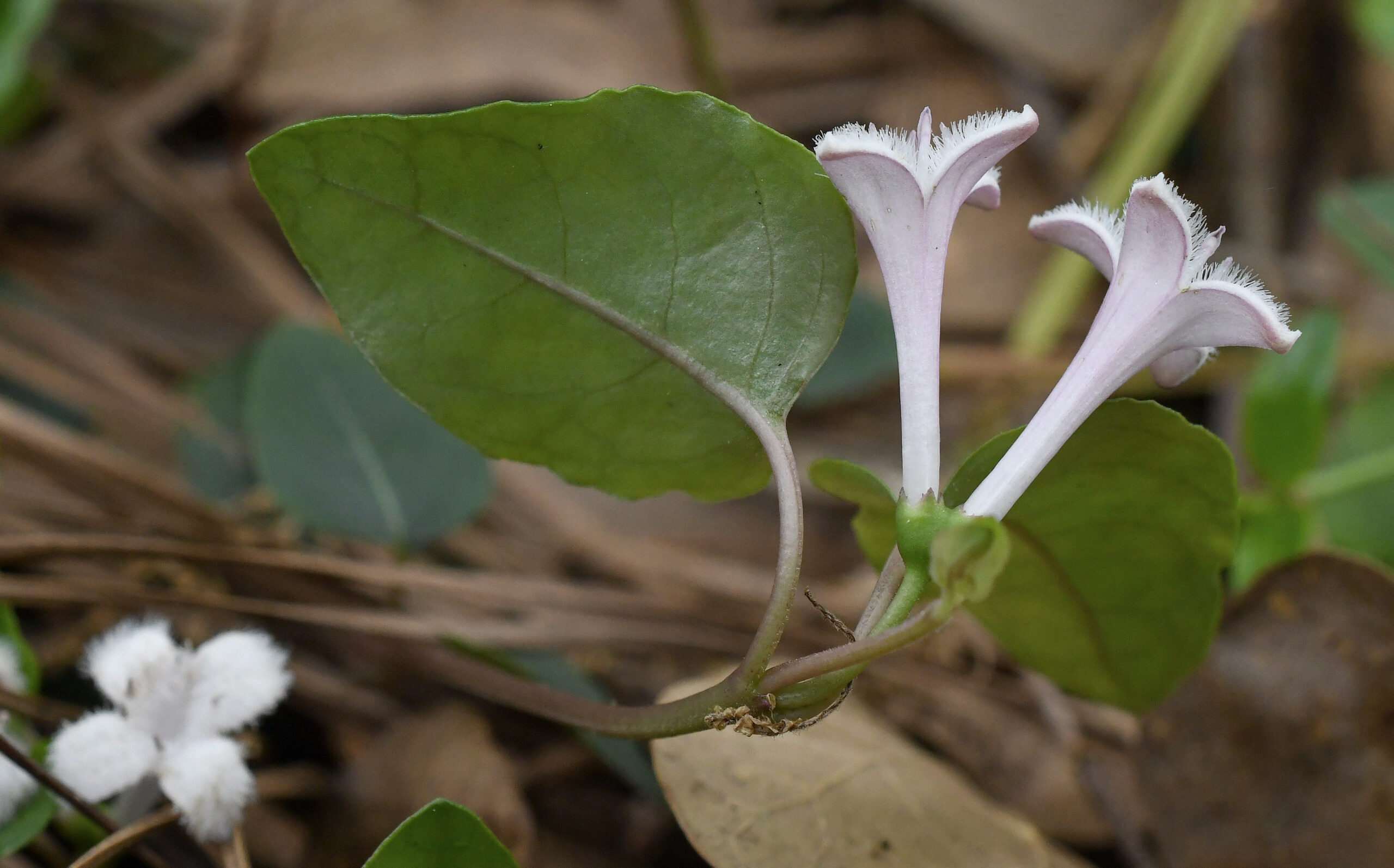
Blooming this month across the Upstate, the native partridgeberry or twinflower (Mitchella repens) is found on the floor of its woodland habitats. If you’re lucky enough to spot it, examine it closely to note its interesting floral structure.
The paired white flowers come in two forms: 1) Thrums have 4 long stamens (pollen-producing male parts) and 1 short pistil (female part with 4 stigma tips to capture pollen). 2) Pins are the opposite. They have a long pistil (that splits into several pollen-receiving stigmata) and 4 short stamens.
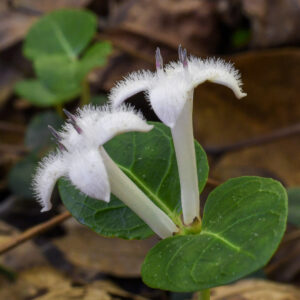
Thrum flowers have four long pollen-producing stamens and a single short pistil to receive pollen. Photo by Jon Storm.
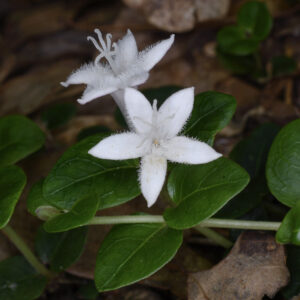
Pin flowers have a single long pistil to receive pollen and four short stamens that produce pollen. Photo by Jon Storm.
Partridgeberry grows in clumps of just one of these flower types, and each type can only be fertilized by the opposite flower morph. As bumblebees pass between clumps of partridgeberry, they cross-pollinate the flower morphs. If both paired flowers are pollinated, a single red fruit will develop over the spring and summer. The fruit may be retained through the winter if it’s not quickly consumed by songbirds or small mammals.
Partridgeberry is a good native groundcover for woodland gardens. I have a patch of it growing in a woodland garden in my yard. I have found that partridgeberry will form a nice mat of evergreen groundcover if you are a bit patient.
The genus Mitchella honors John Mitchell, designer of the Mitchell Map. This map was used to determine the boundaries of the United States during negotiations for the Treaty of Paris that ended the Revolutionary War.
You can find planting information for partridgeberry in our Native Plant Directory.
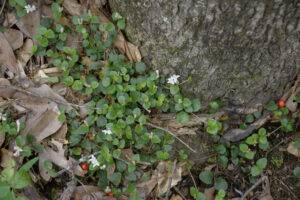
White flowers of partridgeberry and red fruits produced the previous summer. Photo by Jon Storm.
References
https://www.missouribotanicalgarden.org/PlantFinder/PlantFinderDetails.aspx?kempercode=b345
