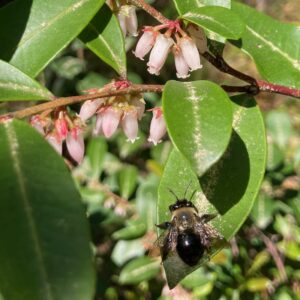
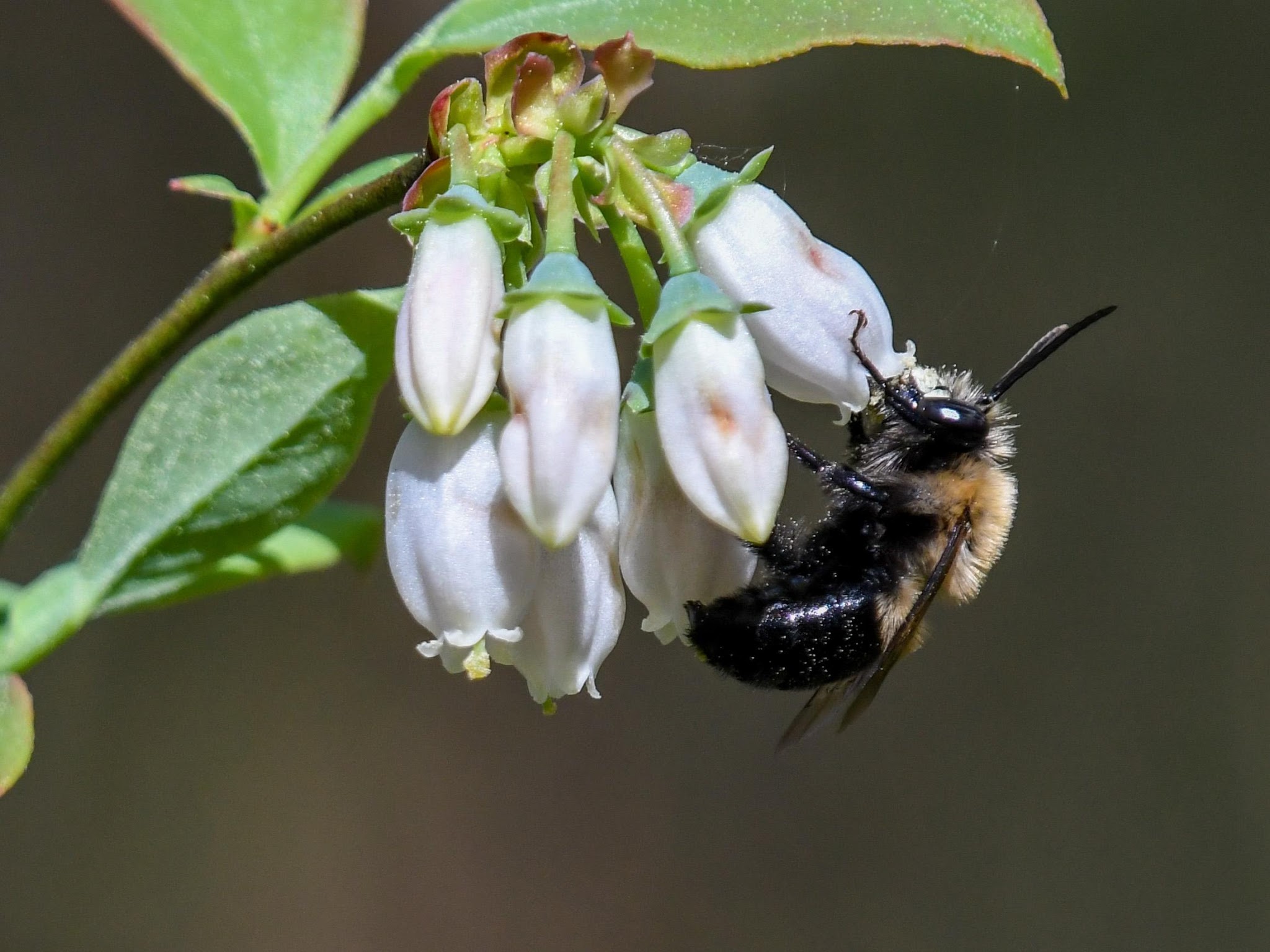
The relationships native plants have with insects and animals is extraordinary and complex! We’ve started this series to give you a view into how amazing these plant partnerships are, starting with the Southeast blueberry bee.
First, that name: southeast blueberry bees are concentrated in Southeastern states but range north into New England, West to Illinois, and south to Texas and Florida. Another name is blueberry digger bee, since they are in the genus Habropoda, known for digging nests in the ground.
They use North American blueberry plants (genus Vaccinium) almost exclusively for food and to raise larvae, and the bees and plants have shaped each other over eons. One aspect of that is timing: blueberries bloom in late winter in our region. Rabbiteye types (commonly grown commercially) and other blueberries start blooming in February, and blueberry bees are emerging from their nests to greet them. They are adapted to flying in temperatures colder than western honeybees are, one reason they’re much more effective blueberry pollinators.
Pollinating Powerhouses
The second reason is mechanical: blueberry pollen is held inside flower anthers and has to be shaken out through tiny pores. Crawling around on blueberry flowers isn’t enough for bees to reach that pollen. Blueberry bees get to it using a muscular feat called buzz pollination, or “sonication.”
To start, bees grab hold of a flower usually with their mandibles, then vibrate their wing muscles at high frequencies to physically shake out pollen. It’s an adaptation blueberry bees, bumblebees, and a few other bee species evolved that honeybees did not. Honeybees can still pollinate blueberries, though less efficiently, and are widely used by commercial blueberry growers along with managed native bumblebees.
Check out this slo-mo video of a bumblebee sonicating. (It’s using a plant in the Solanaceae family, which also requires buzz pollination.) Along with Vaccinium species, blueberry bees sometimes forage on redbuds and Carolina jessamine.
The bee’s scientific name, Habropoda laboriosa means “delicate-footed hardworking.” All their labor amounts to massive fruit production for such a tiny creature, hordes of fruit that feed untold numbers of birds and mammals, and people, too. According to UGA, “a single adult female southeastern blueberry bee can visit up to 50,000 rabbiteye blueberry flowers, producing more than 6,000 ripe blueberries, equated in 1997 to a yield valued at more than $20 (Cane, 1997). Adjusted for inflation, that comes to $40.25 in 2025 dollars.”
Pretty amazing given their short time on Earth! Adult blueberry bees live only 3 – 5 weeks. Females must hurry to forage for food, mate, dig and prepare nests, collect pollen and nectar stores, lay eggs, and secure the finished nest. Their short lifespan is common for bees.
How can I help?
The answer is the same regardless of bee species: give them an undisturbed place to nest, grow the plants they’re looking for, and don’t use pesticides and herbicides.
Blueberry bushes happen to be beautiful landscape plants, and we encourage everyone to find some that work in your garden conditions. Some require boggy soil but others will grow well in garden soil with regular watering. There are about a dozen species native to South Carolina, some readily available in nurseries:
V. arboreum (sparkleberry), V. corymbosum (highbush blueberry), V. crassifolium (creeping blueberry), V. elliottii (Mayberry), V. formosum (Southern highbush blueberry), V. fuscatum (black highbush blueberry), V. myrsinites (Southern evergreen blueberry), V. pallidum (hillside blueberry), V. stamineum (deerberry), V. tenellum (Southern dwarf blueberry), V. virgatum (rabbiteye)